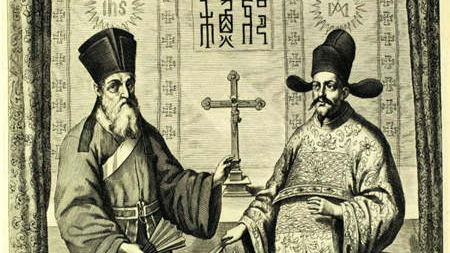
Matteo Ricci
Overview
Matteo Ricci (1552-1610) was an Italian Jesuit priest and one of the founding figures of the Jesuit China missions. He is renowned for his pioneering work in cultural and scientific exchanges between the West and China during the late Ming Dynasty (1368-1644). Ricci's efforts laid the groundwork for Christianity's introduction to China and played a significant role in establishing cultural dialogue and exchange.
Early Life and Education
Matteo Ricci was born on October 6, 1552, in Macerata, Italy. He joined the Society of Jesus (Jesuits) in 1571 and studied in Rome, where he focused on mathematics and astronomy, disciplines that would later prove essential in his mission to China. His education equipped him with the knowledge and skills that were instrumental in bridging European and Chinese cultures.
Arrival in China
Ricci arrived in China in 1582. He spent several years learning Chinese language and culture, which was crucial for his mission's success. Ricci adopted a strategy of cultural accommodation, respecting Chinese customs and practices, which facilitated his acceptance among the Chinese elite.
Cultural Exchange and Scientific Contributions
Ricci is credited with introducing Western scientific knowledge to China. His expertise in astronomy and mathematics was highly valued, and he shared European scientific concepts, including the Gregorian calendar and Euclidean geometry, with Chinese scholars. Ricci translated several significant Western works into Chinese, including parts of Euclid's Elements, and introduced Western cartography to China through his world map, "Kunyu Wanguo Quantu", which presented a more accurate view of the world according to European understanding.
Influence
Ricci's mission was primarily religious, aiming to spread Christianity in China. He adopted a respectful and learned approach, engaging in dialogue with Confucian scholars and officials. Ricci's efforts in translating Christian texts into Chinese, including the "True Meaning of the Lord of Heaven", helped in promoting Christianity, although widespread conversion remained limited during his lifetime.
Matteo Ricci's work laid the foundation for future Jesuit missions in China and set a precedent for cultural and intellectual exchanges between China and the West. His approach to cultural accommodation became a model for missionary work, emphasizing respect and understanding of local traditions. Ricci's influence extended beyond religion; his work contributed to a deeper mutual understanding between Eastern and Western civilizations.
Ricci befriended many members of the Chinese elite, including Xu Guangqi, a prominent scholar and scientist. Their collaboration resulted in the translation of European scientific texts and fostered intellectual exchanges that enriched both cultures. Ricci's relationships with Chinese scholars played a pivotal role in the acceptance of Western ideas in China. Article reference1. On his majesty's service, and at his mercy. chinadaily.com.cn. 2017Photo Gallery(11 pictures)CategoriesCultural ExchangeTagCultural EnvoyHistorical FiguresRelatedChina StudiesFour Great AcademiesLi ZhizaoXu GuangqiCatalogue1. Overview2. Early Life and Education3. Arrival in China4. Cultural Exchange and Scientific Contributions5. Influence- - - []








